You can move money to a new wallet. You cannot move your medical history to a new past.
That is where I would start any conversation about AI, quantum computing and cryptography. Bitcoin is an obvious target for the discussion: valuable assets, public keys, a market price that reacts to fear. It is also a very incomplete picture.
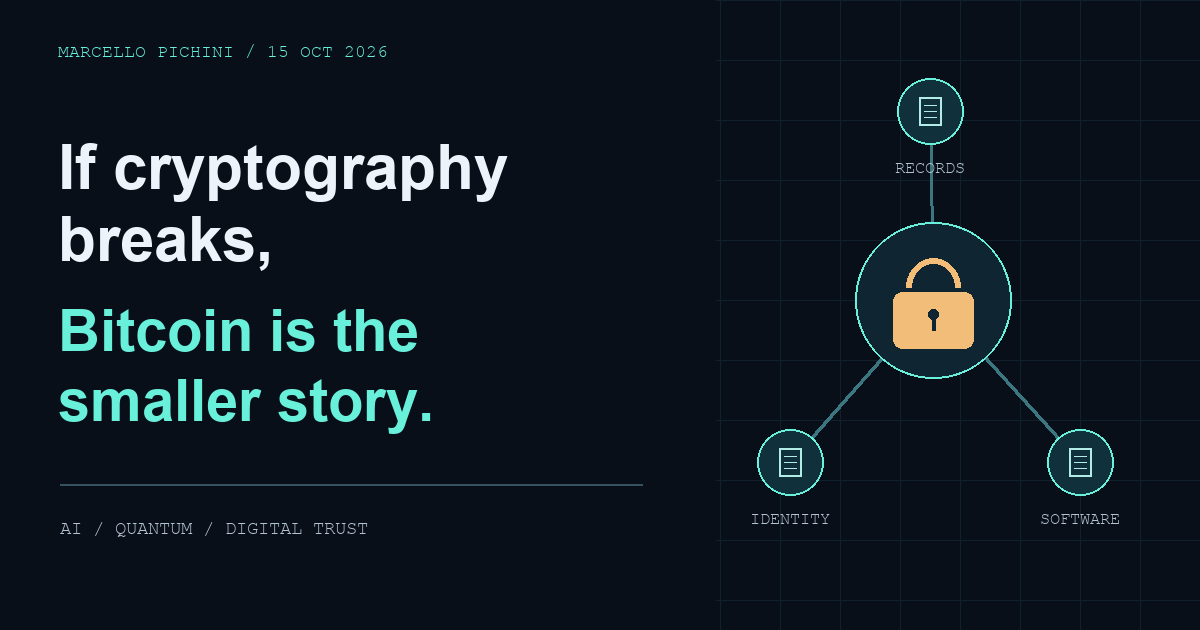
The same broad families of cryptographic tools help keep conversations private, authenticate websites and decide whether a software update came from the company whose name appears on it. A serious failure there would reach people who have never owned a token.
So when I say cryptocurrencies could be the least of our problems, I mean the consequences for society. I don’t mean wallets are safe, or that blockchains can fix themselves overnight. First, though, we need to separate two threats that keep getting bundled together.
What exactly is “AI-resistant” supposed to resist?
“Quantum-resistant” refers to a reasonably specific technical objective. “AI-resistant” is much harder to pin down. There is no comparable, generally accepted cryptographic standard behind that label. Before buying anything with it on the box, I would want to know the attacker’s capabilities and what has actually been tested.
An AI system might help find a bug in a cryptographic library. It might improve a password-guessing strategy or help someone impersonate an employee convincingly enough to obtain access. Those are serious failures. They do not, by themselves, establish that the underlying encryption algorithm has been broken.
The UK’s National Cyber Security Centre assessment through 2027 puts particular emphasis on AI-assisted vulnerability research and exploitation. Its concern is that attackers get better at finding and using weaknesses in code and configuration. That is already a useful threat model. It gives defenders something concrete to fix.
Machine learning also has a legitimate place in cryptanalysis. Aron Gohr’s research on reduced-round Speck showed that neural networks could improve attacks in that setting. The words reduced-round matter: the researchers studied a version with fewer rounds of cryptographic processing. That result is not evidence of a practical break of full-strength AES.
Could AI help discover a much more powerful mathematical attack? I would not rule it out. I also would not turn that possibility into a claim that a model can currently decrypt anything placed in front of it. An attack needs a method, a cost and a result other researchers can examine.
For now, the useful question is whether a system can survive a more capable attacker. A strong cipher offers little comfort if an agent has persuaded the application to hand over the plaintext.
Quantum computing comes with a specific mathematical problem
Shor’s algorithm gives a sufficiently capable quantum computer an efficient way to solve integer factorisation and discrete logarithms. Those problems underpin widely used public-key systems, including RSA and elliptic-curve cryptography. This is why the quantum concern has a clearer technical foundation than “the AI gets clever enough”.
The hardware qualification is enormous. Knowing the algorithm does not mean having a fault-tolerant machine able to run it against real-world keys at a useful cost. There is no reliable date to put in a countdown widget.
Nor does this mean every form of encryption fails together. Symmetric encryption, such as AES, faces a different quantum threat. Grover’s algorithm offers a theoretical quadratic improvement in generic key search, with substantial implementation costs; it does not give AES the same structural failure as Shor gives RSA. NIST’s discussion of quantum security explains why those distinctions affect parameter choices. “Quantum breaks encryption” is too crude to guide a migration.
| Question | AI-assisted attacks | Quantum attacks |
|---|---|---|
| What changes? | The ability to find, automate and exploit weaknesses; potentially cryptanalytic research too. | Known algorithms change the difficulty of specific mathematical problems. |
| What must we avoid assuming? | That better models automatically defeat sound cryptography. | That today’s hardware can already break production keys, or that every primitive is equally exposed. |
| What helps? | Hardened implementations, protected keys and tightly controlled access. | Migration of vulnerable cryptography to reviewed post-quantum schemes and protocols. |
Post-quantum doesn’t mean a quantum computer on your desk
Post-quantum cryptography runs on ordinary computers. It uses mathematical constructions intended to withstand both classical and quantum attacks.
In August 2024, NIST finalised its first three standards: ML-KEM, ML-DSA and SLH-DSA. The last two provide digital signatures. ML-KEM establishes a shared secret, which a system can then use with symmetric encryption to protect the actual data. These are different jobs; replacing one does not automatically replace the others.
“Resistant” also leaves room for uncertainty. Security depends on assumptions, parameters, implementation and continuing scrutiny. A future mathematical discovery could change our assessment, whether a human, an AI system or a combination of both makes it.
That is the real parallel between the two debates. We need systems whose cryptography can be replaced without rebuilding the entire organisation. Calling something “AI-proof” would give me less confidence than a credible plan for what happens when its security assumptions change.
The theft can happen before the decryption
Imagine an attacker records an encrypted exchange containing sensitive medical information. They cannot read it today, but they keep the recording. If the exchange relied on a public-key mechanism that becomes breakable later, the old traffic may become readable too.
This is the “harvest now, decrypt later” problem described by NIST. Updating the system after that point protects future communications. It does not retrieve the attacker’s copy.
- 01 / CAPTUREEncrypted traffic is copiedThe attacker does not need to read it yet.
- 02 / KEEPThe recording survivesYour software may be updated. Their copy stays the same.
- 03 / DECRYPTA vulnerable exchange is brokenOld information can become readable if the required capability arrives.
Illustrative sequence, not a forecast. It applies to data whose protection depends on a mechanism that later becomes breakable.
There is an important boundary here. A properly protected AES-256 archive does not become readable merely because RSA becomes vulnerable. How its keys were generated, stored and exchanged matters. “Encrypted” is the beginning of the question, not the end.
My concern is the lifetime of the information. A password can be replaced. A medical diagnosis, a genetic record or the identity of a confidential source can remain sensitive for decades. The people affected do not get a reset button.
That changes the timing of the work. If information needs to stay confidential for twenty years, the relevant question is whether its protection will last twenty years. Waiting for a convincing demonstration of the attack may already be waiting too long.
And then there is the question of who you trust
Encryption gets most of the attention because secrecy is easy to explain. Digital signatures deserve at least as much.
Consider a software update accepted because its signature verifies against a trusted public key. If an attacker can derive the signing key, that check can no longer distinguish the legitimate publisher from the forger. Extra controls may still help, but one of the system’s foundations has failed.
Now extend that thought to certificates, device identities and long-lived equipment that depends on signed firmware. The migration problem includes finding every verifier and making sure it understands the replacement scheme. Some of those verifiers sit in hardware that nobody intended to replace for years.
This is why I would put healthcare, sensitive government communications and critical software infrastructure ahead of token prices in a discussion of social harm. That is a judgement about consequences, not a prediction that all these systems will fail at once.
Bitcoin still has a real problem to solve
A public blockchain is largely readable already. The quantum concern is not that somebody finally “decrypts Bitcoin”. It is that vulnerable signatures could let an attacker authorise spending.
Bitcoin uses elliptic-curve signatures; BIP 340 specifies Schnorr signatures over secp256k1, the curve also used by its ECDSA signatures. A sufficiently capable quantum attacker targeting an exposed public key would threaten that security assumption. Which funds are exposed, and when, depends on how keys and addresses are used. Signature security and mining’s hash computations also need separate analysis.
Migrating funds to a supported, safer scheme before an attack is possible could help. Getting there requires agreement on protocol changes, wallet and custody support, and people actually moving their funds. Lost keys, inactive owners and disputed treatment of legacy coins make “just upgrade” an inadequate answer. A fork is not a guarantee that everyone gets their money back.
And stolen savings are not a minor inconvenience. Crypto losses could spread through businesses and households. I would take that seriously while still rejecting the idea that Bitcoin’s price captures the full cost of a cryptographic failure.
What I would ask a team to do now
I would start by asking where cryptography is used, who owns those systems and how long the protected information needs to remain private. That inventory should include suppliers, backups and devices, not just the application the team happens to be building.
For quantum readiness, I would want a tested migration path using reviewed standards and supported implementations. Key exchange, signatures and verification all need attention. The awkward integration work matters more than announcing support for an algorithm.
For AI, I would look closely at access. An agent that can read everything and approve its own actions is a security problem regardless of the cipher underneath it. Keep private keys out of model context. Enforce permissions and transaction limits in systems the model cannot talk its way around. Make sensitive actions require an independent check.
There will be plenty of companies selling reassurance under a new label. I would rather see evidence that keys are protected, permissions are narrow and the team can replace a vulnerable component without losing control of the service.
I care about digital assets. But if the mathematics protecting them starts to fail, my first question won’t be where Bitcoin trades. It will be which records are already in somebody else’s archive, and which systems still trust a signature they should no longer accept.